SEA-DOO 210 CHALLENGER SE
Get digital control in this new jet-powered runabout.
Among the many features of the new 210 Challenger SE runabout from Sea-Doo, it’s the iTC (Intelligent Throttle Control) that packs a wow factor. The iTC system is throttle-by-wire leveraged to the max, with not just speed control, but also dual engine synchronization and selectable operation modes designed specifically for docking, economy and tow sports. It’s cool stuff.

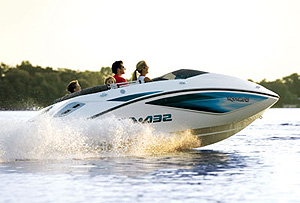
The new Sea-Doo 210 Challenger is styled with creases and hard edges in both the fiberglass and the upholstery.
The 20-foot six-inch 210 Challenger SE starts at $38,699 with a trailer. Base power is a pair of 1503cc, 155-hp Rotax triple-cylinder engines with fuel injection. Pay a $5,000 premium, and you can option up to dual 215-hp engines, each with an intercooled supercharger. Top speed with the base 310-hp package is about 46 mph, but jumps to 55 mph with 430 hp under the hatch.

Huge wet storage locker in the swim platform is well-drained and puts gear in easy reach.
You get iTC with either engine package. A single lever throttles and shifts both engines with a smooth, progressive control. Engine sync was invisible. Once you engage a computer, of course, you can train it to do all sorts of tricks. On this Sea-Doo, they start with basic cruise control that holds any pre-set speed. Or press a button on the dash to select Economy Mode, and the computer tempers fuel consumption by restricting boat speed to its most economical range, usually between 33 and 37 mph. Docking Mode reduces sensitivity to throttle input, so the entire throw of the lever only delivers 3500 rpm, making it much easier to handle the boat at low speeds without getting an unintended burst of power.
Finally, there is Ski Mode, which includes five pre-programmed acceleration profiles, from mild to wild. You select a target speed and a profile, and then just punch the throttle. Select profile number one and the boat accelerates gently, perfect for kids on a tube. An experienced slalom skier will probably prefer a more-aggressive profile. Thanks to built-in GPS and the computer, the system is perfectly repeatable run after run, and allows the driver to focus on the water ahead and the action behind the boat, rather than the speedometer.

Dash incorporates analog instruments and an LCD info screen. Stereo remote is to the left of the wheel.
The pilot who controls all this technology is presented with a spiffy new dash with analog gauges flanking an LCD information screen that displays a clock, fuel consumption data, a depth sounder, a compass, and more. To the left of the wheel is a control panel for the Jensen sound system (located securely in the console) which has a radio and USB input but no CD player, because who has CDs anymore?
Each of the bench seat bottoms is hinged to reveal stowage, which is smooth fiberglass that will be easy to dry and clean. There’s an anchor locker and boarding ladder under a hatch in the bow peak, more stowage in a ski locker, and in each console.

New Transat loungers unfold over the swim platform as easy as 1,2,3.
A walkthrough at the transom provides easy access to the swim platform. Here you will encounter the new Transat seats. Each has a padded fiberglass lounger bottom that unfolds from beneath the sunpad, which in turn becomes the seat back. There’s a stereo remote and a socket for the snack table on the platform, too. But with both seats deployed, most of the space on the platform is occupied. And if you want to access the huge wet-stowage compartment that’s under the platform, both seats need to be folded back up. I think the bi-level design of the platform on Yamaha runabouts is more functional, although those boats don’t have this wet stowage, and may offer less room in the cockpit.
Speaking of Yamaha, the most direct comparison to the new 210 Challenger is the 21-foot Yamaha 212SS ($38,299 with trailer), which has twin 160-hp engines and can reach about 51 mph. Jet power limits the performance of both these boats because they don’t have trim. Of course, they also don’t have propellers to ding on the bottom, and require much less maintenance than a sterndrive.
I drove a pre-production example of the 210 Challenger on the Potomac River for a few hours, and found that all of the iTC features worked as advertised, except for the Economy Mode, which was suffering a software glitch. Which is the problem with digital technology, I suppose. BRP says it’s all been fixed. With 430 hp on the other end of the wire, this boat leaps on plane and will cruise along effortlessly at 40 mph, though it always feels a little light in the bow, like it’s not quite locked on course. I also noted significant driveline harmonics seeping in the cockpit, including an annoying rumble right at wakeboarding speed. We had the same issue with the new Yamaha, for the same reason – the entire jet drivetrain is mounted within the boat. If it’s not isolated well, the hum of the drive shaft and of water flowing through the pump is amplified by the boat structure. Yamaha fixed this before production, and I assume BRP is working on it.

I sometimes think Sea-Doo embraces technology just because it can, but the iTC features on this boat are just right. Each enhances the experience and is really functional. For now, BRP is way out front in this regard.